
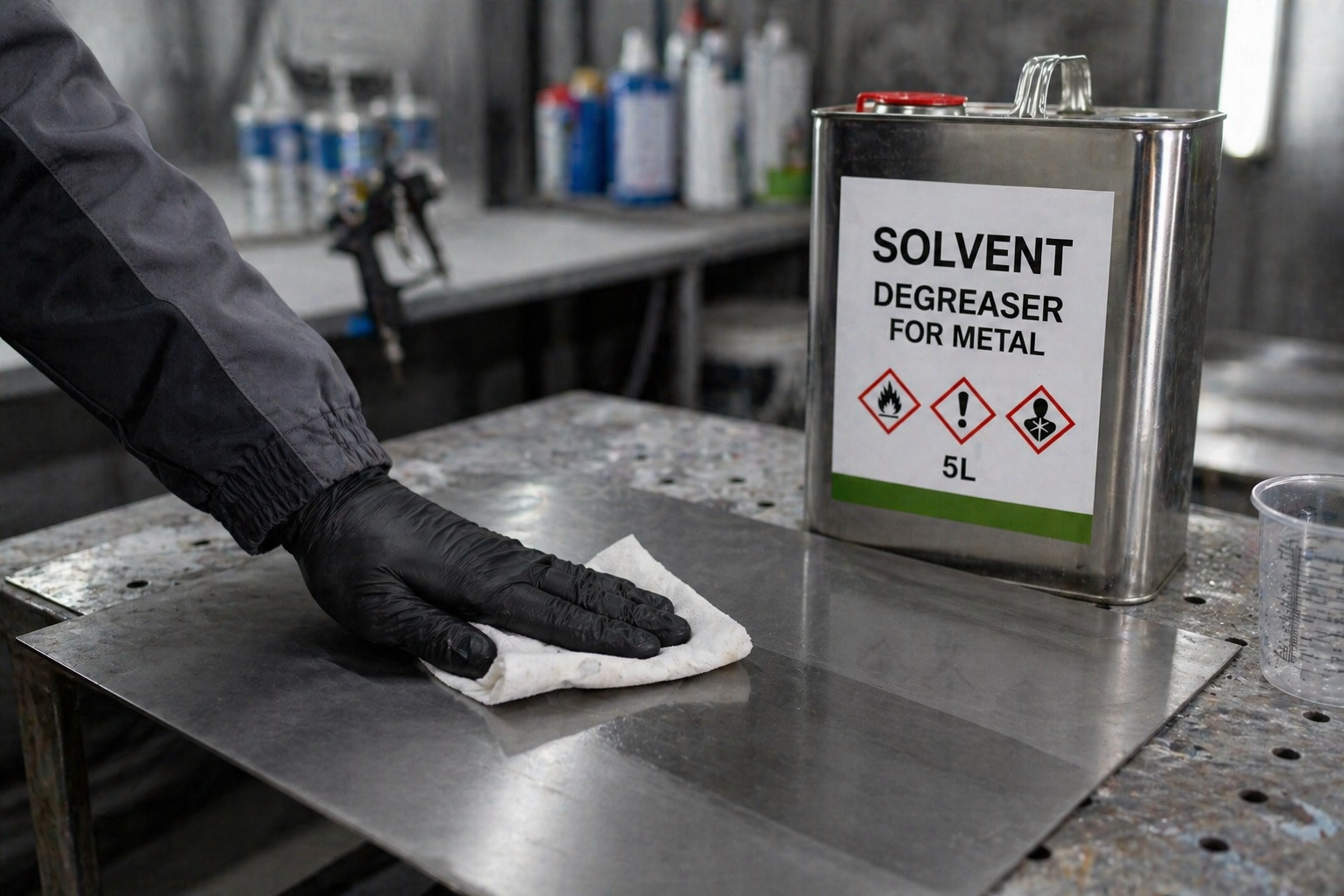
High-quality metal painting does not begin with choosing the paint, but with proper surface preparation. One of the most important stages of this preparation is degreasing the metal before painting. If this step is skipped or done incorrectly, even good paint, primer, or enamel may be applied unevenly, adhere poorly, or quickly lose its properties.
Metal surfaces often have traces of oils, technical fluids, dust, old contamination, fingerprints, grease, or polishing residues. All of this interferes with proper coating adhesion. That is why, before applying any paint or coating material, it is important to choose the right cleaning agent.
In this article, we explain how to degrease metal before painting, which solvent is suitable for this purpose, what to pay attention to when choosing one, and which mistakes should be avoided.
Why degreasing metal before painting is essential
Even if the metal looks clean, this does not mean it is ready for painting. There may still be invisible residues of grease, oil, or other substances on the surface that affect adhesion between the coating and the substrate.
If degreasing is not performed, the following problems may occur:
- poor adhesion of primer or paint;
- coating peeling;
- appearance of craters, stains, or unevenness;
- reduced durability of the coating;
- uneven drying;
- defects in the final layer.
That is why degreasing is a basic preparation step both in household painting and in professional technological processes.
What must be removed from the metal surface before painting
Before applying primer or paint, everything that may reduce adhesion must be removed from the metal surface.
Most often, this includes:
- grease;
- technical oils;
- dust;
- dirt;
- fingerprints;
- polishing paste residues;
- light chemical contamination;
- residues of old auxiliary materials.
If the surface also has rust, mill scale, old paint, or heavy mechanical contamination, solvent degreasing alone will not be enough. In such cases, mechanical cleaning is required first.
What properties a solvent for degreasing metal should have
Not every solvent is equally suitable for degreasing. It is important that the product:
- effectively removes greasy and oily contamination;
- evaporates quickly;
- does not leave an unwanted residue on the surface;
- does not worsen the condition of the metal;
- is compatible with the subsequent coating system;
- does not cause undesirable reactions with the material that will be applied after cleaning.
The main rule is simple: for degreasing, you should use not just “whatever is available,” but a product that is actually suitable for this specific task.
How to degrease metal before painting
Organic solvents are often used for degreasing metal surfaces before painting because they remove technical contamination well and dry quickly.
The choice depends on:
- the type of metal;
- the degree of contamination;
- the coating application method;
- the required surface cleanliness level;
- the following material to be applied — primer, enamel, paint, or varnish.
The best options are products that leave the surface clean, free from residual film, and do not reduce adhesion.
When organic solvents are suitable for degreasing
Organic solvents are often used for metal preparation in the following cases:
- before priming;
- before painting metal structures;
- in repair work;
- in automotive painting processes;
- before enamel application;
- before local repainting or surface restoration.
They help quickly clean metal from most common contaminants that interfere with proper coating application.
What to pay attention to when choosing a solvent for degreasing
To achieve a good result, several important factors must be considered.
Surface type
Not all metal surfaces behave the same way. One approach may work well for rough metal structures, while another may be more suitable for delicate or thin surfaces. If there are sensitive elements, adjacent coatings, plastic, or rubber parts, this must also be taken into account.
Degree of contamination
If the surface only has light fingerprints or dust, one approach may be sufficient. But if there is technical oil, grease, residues of working fluids, or dense contamination, a more effective solvent or combined cleaning may be required.
Subsequent coating
The degreasing solvent must not interfere with the application of the next layer. That is why it is important to consider what will be applied next:
- anticorrosion primer;
- primer-enamel;
- enamel;
- paint;
- varnish.
The cleaned surface must remain technologically suitable for further treatment.
Evaporation speed
For degreasing, it is convenient to use products that evaporate quickly after cleaning and leave no traces. This speeds up the process and reduces the risk of defects before painting.
What should not be done when degreasing metal
Incorrect degreasing often causes almost as many problems as skipping the process completely.
The most common mistakes are:
Using a random solvent
Not all products are equally suitable for cleaning the surface before painting. A poor choice may leave residue, damage the base, or negatively affect the coating.
Degreasing with a dirty cloth
If the wipe or cloth already contains oil, dust, or residues of other substances, instead of cleaning the surface, you will simply spread contamination over it.
Working on an unclean base
If the metal has dust, scale, rust, or residues of old coating, mechanical cleaning must be done first, and only then degreasing.
Touching the cleaned surface with bare hands again
After proper cleaning, the metal should not be touched with bare hands, otherwise grease traces will remain on it again.
Painting too quickly
After degreasing, the surface must be allowed to dry completely if required by the technology and the specific product used.
How to properly degrease metal before painting
The general working sequence looks like this:
- Clean the surface from dust, dirt, rust, or residues of old materials.
- Prepare a clean wipe, cloth, or other suitable cleaning material.
- Apply the degreasing agent to the wipe or according to the product application method.
- Thoroughly treat the surface without missing any areas.
- Make sure no film, traces, or repeated contamination remain after cleaning.
- Do not touch the cleaned surface with bare hands before the coating is applied.
- After that, proceed to priming or painting.
Can a universal solvent be used for degreasing
In some cases, universal solvents can be used to clean metal, but this is not always the best solution. Universal use does not necessarily mean the product is optimal specifically for surface preparation before painting.
The key question is not only whether the product removes dirt, but also whether it leaves the surface suitable for the following primer or paint application.
That is why, before choosing, it is worth considering:
- the manufacturer’s recommendations;
- the type of future coating;
- the nature of the contamination;
- the required final result quality.
What the result should be after proper degreasing
After proper degreasing, the surface should be:
- clean;
- dry;
- free from oily traces;
- free from dust;
- free from foreign film;
- ready for the application of the next layer.
This is exactly the condition of metal that provides a proper base for good adhesion and a durable coating.
Conclusion
Choosing the right solvent for degreasing metal before painting is an important part of surface preparation. This stage affects how well the primer, paint, or enamel will adhere, whether defects will appear, and how durable the finished coating will be.
For a quality result, it is necessary to consider the surface type, degree of contamination, future coating system, and the properties of the solvent itself. The best solution is to use a product specifically suitable for cleaning metal before painting rather than relying on random choices.
Need help selecting a solvent for degreasing metal before painting? Contact TOP KHIM specialists — we will help you choose the best option for your production, workshop, or commercial direction.