
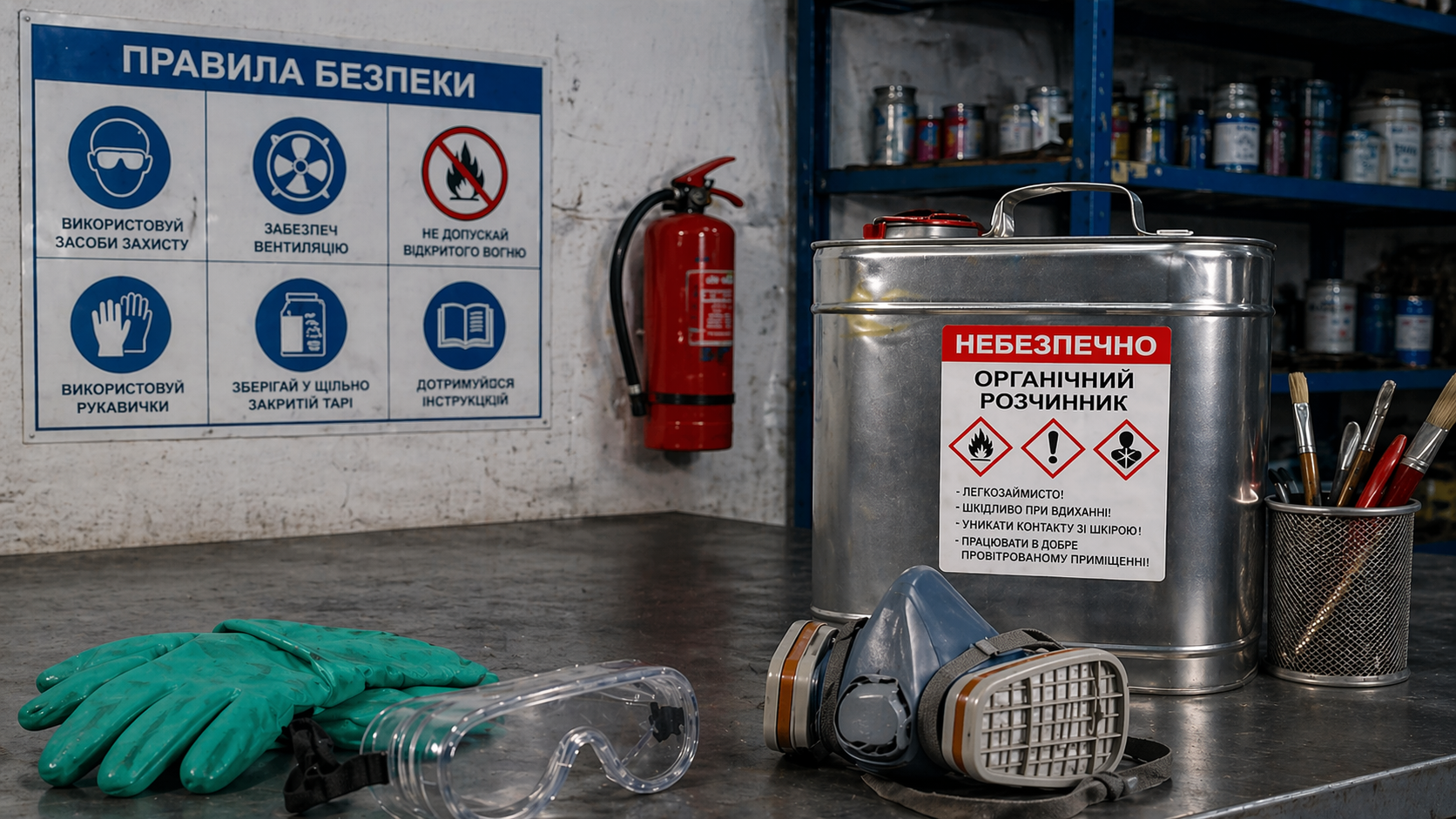
Organic solvents are widely used in manufacturing, painting, repair work, equipment maintenance, and many technological processes. They are needed for thinning paint and coating materials, cleaning tools, degreasing surfaces, and preparing substrates for further treatment. However, along with their practical benefits, solvents also involve potential risks.
The main hazard of organic solvents is related to their volatility, flammability, and possible impact on human health when used improperly. That is why safety rules for working with such products are not just a formality, but an essential condition for safe operation both in industrial production and in workshops.
In this article, we will explain which safety rules should be followed when working with organic solvents, what mistakes occur most often, and how to minimize risks for personnel, equipment, and premises.
Why organic solvents require special caution
Organic solvents evaporate quickly, create vapors, and may ignite easily in the presence of an ignition source. In addition, prolonged or intensive contact may negatively affect the skin, eyes, and respiratory system.
The most common risks when working with solvents include:
- ignition of vapors;
- formation of an explosive environment in poorly ventilated spaces;
- irritation of the skin and mucous membranes;
- headaches, dizziness, or nausea caused by inhaling vapors;
- damage to surfaces and materials when used improperly;
- increased danger when working near open flames, sparks, or heating devices.
That is why handling such substances must be clearly regulated.
Where organic solvents are most commonly used
Organic solvents are used in many areas:
- in paint and coating production;
- in metalworking shops;
- at service stations and automotive paint workshops;
- in woodworking;
- in repair work;
- in printing;
- in household and semi-professional applications.
Regardless of the scale of use, the basic safety rules remain equally important.
Basic safety rules when working with organic solvents
To reduce risks, several mandatory rules should always be followed.
Work only in a well-ventilated area
Solvent vapors must not accumulate in the working area. If ventilation is weak or absent, the concentration of vapors can quickly rise to a dangerous level.
Important points:
- ensure a constant supply of fresh air;
- use local exhaust ventilation where possible;
- do not work with large volumes of solvent in closed, unventilated rooms;
- in industrial conditions, make sure the ventilation system matches the type of work being performed.
Good ventilation reduces both the risk of ignition and the physical burden on the worker.
Avoid open flames and sources of sparks
Organic solvents belong to flammable substances. Even a small spark can cause solvent vapors to ignite.
During work, it is prohibited to:
- smoke near the place where the solvent is used;
- use open flames;
- work near heating devices that may become ignition sources;
- switch faulty electrical equipment on or off near the evaporation zone;
- perform spark-producing work without proper protective measures.
Special attention should be paid to areas where solvent is poured, mixed, or used in large quantities.
Use personal protective equipment
When working with organic solvents, it is important to protect the skin, eyes, and respiratory organs.
Depending on the working conditions, the following may be required:
- protective gloves resistant to chemicals;
- safety goggles;
- work clothing;
- a respirator or another type of respiratory protection;
- a protective apron or additional protective clothing in case of intensive contact.
The choice of protection depends on the volume of work, the type of solvent, and the method of application.
Prevent contact of the solvent with skin and eyes
Some workers underestimate the risk of direct contact, especially during short-term work. However, even brief exposure may cause irritation, skin dryness, or other undesirable effects.
To avoid this:
- do not work without gloves;
- do not wipe your hands with a rag soaked in solvent;
- do not use solvent to clean the skin;
- if it gets into the eyes, rinse immediately with plenty of water and seek medical attention;
- if it gets on the skin, remove the substance quickly and wash the affected area thoroughly.
Do not use food containers for storage
One of the most dangerous mistakes is pouring solvents into bottles previously used for water, beverages, or other household containers without proper labeling. This creates a risk of accidental misuse and serious emergency situations.
Solvents must be stored:
- only in containers intended for this purpose;
- with clear labeling;
- with tightly closed caps;
- separately from food products and drinking water.
Store organic solvents properly
Safe work begins not only with proper use, but also with proper storage.
Basic storage rules:
- keep containers tightly closed;
- do not leave the product under direct sunlight;
- avoid overheating;
- store away from heat sources, flames, and sparks;
- keep in a dry, cool, well-ventilated place;
- do not store near oxidizing agents, open fire, or highly flammable materials.
In a warehouse or production area, it is advisable to organize a separate place for such products in compliance with fire safety requirements.
Follow the manufacturer’s instructions
Each product may have its own specifics of use: recommended conditions, application areas, restrictions, transportation rules, and storage requirements. That is why, before use, it is necessary to read the label and technical information carefully.
Ignoring the manufacturer’s recommendations often leads to:
- improper use of the product;
- poorer work results;
- increased risk for the worker;
- emergency situations.
What should not be done when working with solvents
It is also important to highlight the most common violations that should be avoided.
Do not work without ventilation
Even if the smell does not seem too strong, it does not mean the vapor concentration is safe.
Do not mix different products without understanding compatibility
Mixing different solvents or other chemical products without technical justification may be dangerous.
Do not leave containers open
Open containers increase evaporation, raise fire risk, and worsen air conditions in the working area.
Do not use solvents near children or unauthorized persons
This is especially important in household conditions, where control over the environment is lower than in industrial settings.
Do not dispose of residues carelessly
Solvent residues must not be poured onto the ground, into drains, or into random containers. Waste handling must be organized and safe.
How to organize a safe workplace
To make working with solvents safer, the workplace should be properly arranged.
Recommended steps:
- keep only the minimum necessary amount of product nearby;
- remove unnecessary items from the work area;
- ensure proper ventilation;
- prepare personal protective equipment before starting work;
- check that there are no ignition sources nearby;
- have primary firefighting equipment suitable for the working conditions;
- train personnel in basic actions in case of spills or fire.
What to do in case of a solvent spill
If a spill occurs, it is necessary to act quickly and without panic.
Basic procedure:
- eliminate ignition sources;
- ventilate the room;
- restrict access for unauthorized persons;
- contain the spill using available safe materials;
- prevent the substance from spreading;
- remove contaminated materials in accordance with waste handling rules.
In industrial conditions, employees should be instructed in advance on how to act in such situations.
Why employee training is essential
Even a high-quality product and good equipment do not guarantee safety if employees do not know how to act properly. Regular instruction, clear rules, and control over compliance are the foundation of safe work with any chemical product.
An employee should understand:
- what exactly they are using;
- what risks the product involves;
- what protective equipment is required;
- how to act in case of contact, spill, or ignition;
- how to store and transport the product properly within the enterprise.
Conclusion
Safety rules for working with organic solvents are not a formal requirement, but a real necessity for protecting employee health, workplace safety, and production stability. The main principles are simple: ventilation, absence of ignition sources, proper storage, use of protective equipment, and compliance with the manufacturer’s instructions.
The better the workplace is organized and the more carefully personnel follow safety rules, the lower the risk of accidents, defective work, and dangerous consequences.
Need advice on choosing organic solvents for production, workshops, or retail outlets? Contact TOPHIM specialists — we will help you choose the right products and recommend the optimal conditions for their use.