
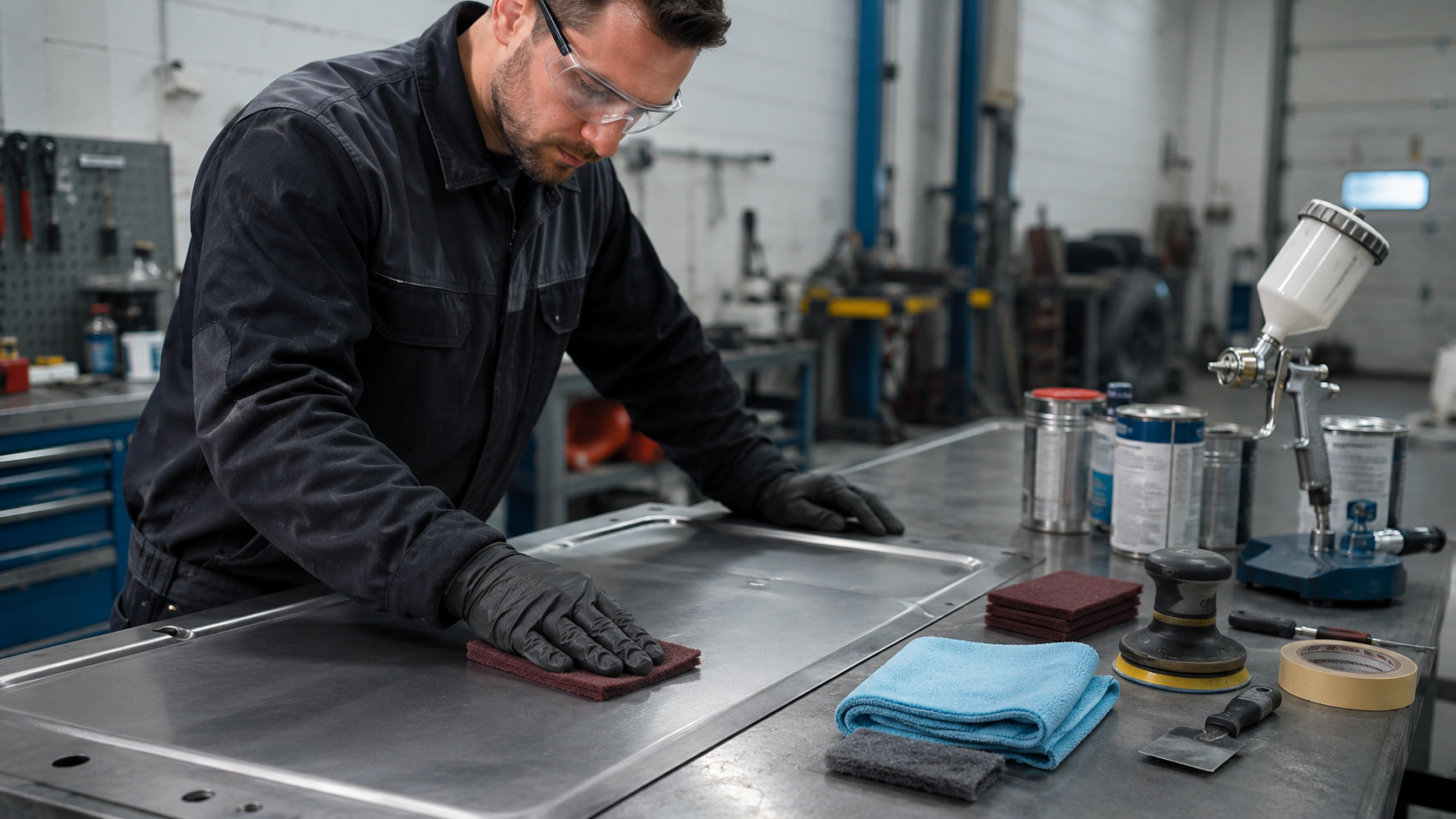
The quality of metal painting depends not only on the paint, enamel, or primer. In most cases, the decisive factor is proper metal surface preparation before painting. If the surface is not cleaned well enough, if rust, dust, grease, or weak old coating layers are left behind, even a high-quality material will not provide the expected result.
It is exactly because of mistakes at the preparation stage that problems such as paint peeling, blistering, uneven application, corrosion under the coating, and a short service life of the painted surface most often occur. That is why, before painting, it is important not only to choose the right material, but also to prepare the substrate correctly.
In this article, we explain how to prepare metal for painting, which stages are essential, what should never be skipped, and how to make sure the coating lasts longer.
Why metal preparation before painting is so important
Paint, primer, or enamel should not be applied over dirt, grease, dust, or rust, but over a clean, stable, and properly prepared surface. Only then can the material achieve proper adhesion and perform as intended by the technology.
If the preparation is done incorrectly, the following consequences may occur:
- weak adhesion of the coating to the metal;
- fast peeling of the paint;
- corrosion appearing under the coating layer;
- stains, craters, or unevenness;
- uneven drying;
- reduced durability of the whole coating system.
In other words, coating durability begins not at the moment of painting, but at the moment of metal preparation.
Where metal preparation before painting begins
The first step is to assess the condition of the surface. Not all metal requires the same preparation. One object may be new and clean, while another may have an old coating, traces of corrosion, dust, oil, or technical contamination.
Before starting work, it is important to understand:
- whether there is rust on the surface;
- whether any old coating remains;
- whether there are traces of oil, grease, or technical fluids;
- whether mechanical cleaning is required;
- whether sanding is needed;
- which material will be applied next: primer, primer-enamel, enamel, or another coating.
The sequence of further actions depends on this.
What contamination must be removed before painting
Before applying the coating, everything that interferes with adhesion must be removed from the metal.
Most often this includes:
- dust;
- dirt;
- rust;
- mill scale;
- weak old coating;
- traces of lubricants;
- technical oils;
- grease;
- fingerprints;
- residues of polishing or auxiliary materials.
If even part of such contamination remains on the surface, the coating may behave unstably.
Main stages of metal preparation before painting
For the coating to last longer, preparation must be done step by step.
1. Cleaning the surface from dirt and dust
The first basic step is to remove superficial contamination. If the metal is dusty or dirty, you should not immediately move on to the next stages.
At this stage, it is important to:
- remove dust;
- clean the surface from household or industrial dirt;
- prepare the substrate for further mechanical cleaning or degreasing.
This is the initial but essential step.
2. Removing rust and weak layers
If the metal has rust, blisters, peeling old paint, or unstable remnants of a previous coating, these must be removed down to a sound base.
For this, the following are used:
- mechanical cleaning;
- sanding;
- abrasive treatment;
- other preparation methods depending on the type of surface and the scale of work.
The main rule is simple: you should not paint over flaking rust or weak old layers unless the coating system specifically allows it.
3. Leveling and matting the surface
In many cases, after cleaning, the metal should be additionally prepared so that the next layer can adhere better to the base. For this purpose, the surface is matted or sanded to the required condition.
This is especially relevant if:
- the surface is too smooth;
- adhesion needs to be improved;
- repainting is being carried out;
- there are local transitions between old and new coating areas.
A properly prepared surface should be uniform, free from unstable areas, and without glossy contaminated zones.
4. Degreasing the metal
After mechanical cleaning and before applying the coating, the metal must be degreased. Even if the surface looks clean, it may still contain grease traces, technical fluids, or contamination invisible to the naked eye.
Proper degreasing helps to:
- remove residual grease and oils;
- improve adhesion;
- reduce the risk of craters and other defects;
- prepare the metal for priming or painting.
After degreasing, the cleaned surface should not be touched with bare hands.
5. Drying the surface
Before applying primer or paint, the metal must be dry. There should be no moisture, condensation, or residues of cleaning agents on it.
An insufficiently dry surface may lead to:
- poor adhesion;
- coating defects;
- corrosion under the material layer;
- unstable drying behavior.
This is especially important when working in cool or humid conditions.
6. Applying primer or a base layer
If the coating system includes a separate primer, it should be applied to properly prepared metal. It is often the primer that provides the base for anticorrosion protection and helps the finishing coat last longer.
The choice between primer, primer-enamel, or another system depends on:
- the type of metal;
- operating conditions;
- the condition of the surface;
- durability requirements;
- the type of final coating.
7. Following the correct sequence of layers
Even well-prepared metal can be ruined if the technology is not followed after cleaning. It is important not to delay the next layer too long once the surface is ready, and also not to break the logic of the coating system.
The longer clean metal is left unprotected, the higher the risk of recontamination or new problems.
How to tell that metal has been prepared correctly
Before painting, the surface should be:
- clean;
- dry;
- free from dust;
- free from grease;
- free from unstable rust;
- free from weak remnants of old coating;
- even;
- suitable for the application of the next layer.
If the metal has this condition, the chances of getting a high-quality and durable coating are much higher.
What is most often done incorrectly
The most common mistakes in metal preparation are:
Painting over a dirty surface
Even a small amount of dust or technical dirt can affect the result.
Ignoring rust
Rust under the coating does not disappear on its own. If it is not removed or treated according to the technology, the problem will return quickly.
Skipping degreasing
Many people underestimate this stage, but grease and oil residues are often the cause of coating defects.
Touching the surface with hands after cleaning
After preparation, the surface should not receive new contamination.
Applying coating onto wet metal
Even a good material cannot compensate for mistakes in the base preparation.
Oversimplifying the system
If the object works in demanding conditions, saving on preparation almost always means a shorter coating life.
How to prepare metal for painting in household conditions
For household work, the principle remains the same: clean, remove weak layers, degrease, dry, and only then paint.
In home conditions, it is especially important:
- not to rush;
- not to use random products;
- not to paint over flaking rust;
- not to apply the coating on a greasy or wet surface;
- to choose the system according to the specific type of metal and operating conditions.
The simplicity of the object does not mean the preparation can be skipped.
How to prepare metal for painting for outdoor structures
If the metal will be used outdoors, the preparation requirements are even higher. Moisture, temperature fluctuations, sunlight, and mechanical stress quickly reveal all weak points of the coating.
For such objects, it is especially important to:
- thoroughly remove corrosion;
- avoid leaving weak layers behind;
- properly degrease the surface;
- use the correct protection system;
- not oversimplify the technology without reason.
For outdoor metal structures in particular, the quality of preparation has the greatest effect on coating service life.
Practical order of metal preparation before painting
To summarize, the sequence looks like this:
- Assess the condition of the surface.
- Remove dirt, dust, and superficial contamination.
- Remove rust, weak layers, and problematic areas.
- Carry out sanding or matting if necessary.
- Degrease the metal.
- Wait until it is completely dry.
- Apply primer or another base material according to the technology.
- After that, proceed to painting.
Conclusion
Proper metal preparation before painting is the foundation of a durable coating. It is at this stage that it is determined how well the paint will be applied, whether it will hold, whether corrosion will appear under the coating layer, and how long the surface will keep a neat appearance.
For the coating to last longer, the basic stages should not be skipped: cleaning, rust removal, degreasing, drying, and the correct choice of coating system. In most cases, preparation has a stronger influence on the result than the paint itself.
Need help selecting solvents, primers, or materials for preparing metal before painting? Contact TOP KHIM specialists — we will help you choose the best solution for your surface type and operating conditions.