
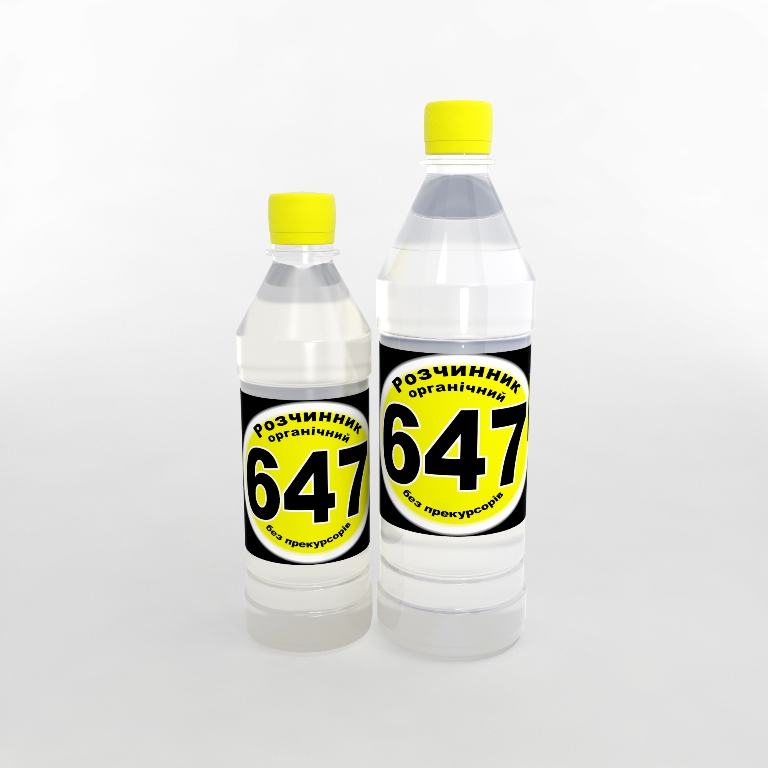
It is hard to imagine the modern market of the chemical industry, machine building, construction products and cars without solvents.
A solvent is a unique chemical compound capable of dissolving certain types of substances and forming homogeneous systems with variable composition.
647 solvent – has a multicomponent composition, does not contain precursors, suspensions or turbidity. It is transparent and has the ability to evaporate quickly, leaving a glossy shine on the paint.
What is solvent 647 for?
Before buying, it is important to understand what solvent 647 is used for in practice!
Solvent 647 is used to remove varnishes and paint coatings, to dissolve nitrocellulose film substances. It is widely used as a solvent for body work, because it is suitable for dissolving nitroenamels and nitrolacquers used in car painting.
In addition, 647 solvent is used for effective degreasing of surfaces, production of leather goods, removal of stains from paints, enamels and varnishes, washing of mechanisms at service stations and cleaning of various painting tools.
Solvent 647 is also ideal for diluting and dissolving the following types of enamels: NC-280, NC-11, NC-132P, AK-194, as well as NC-097.
Features of solvent 647
The main feature of this solvent is that its chemical aggressiveness is reduced, which is why it can be used on delicate surfaces.
Among other characteristics of this solvent, the following are distinguished:
- colorless or yellowish, transparent, without suspended impurities and delamination;
- has an unpleasant smell;
- liquid consistency;
- the density is less than the density of water (870 g / m3);
- has moderate volatility (8-12).
It is impossible not to mention the possibility of 647 solvent to react with oxidizing agents (nitric and acetic acid, hydrogen peroxide) and halogenated hydrocarbons (chloro-, bromoform). As a result of the interaction, explosive substances are formed.
Composition of solvent 647
Solvent 647 is a mixture of volatile organic substances: aromatic hydrocarbons, ketones, alcohols and ethers.
The chemical composition of solvent 647 is close to solvent 646 and includes toluene, butyl acetate, ethyl acetate, butanol. Solvent 646 is considered more aggressive.
This solvent does not contain ethyl cellosolve and acetone. This explains its moderate aggressiveness and the possibility of use on sensitive surfaces.
Advantages of solvent 647
The popularity of this type of solvent is due to its advantages:
- Safety of use. Due to the fact that there are no aggressive substances in the composition of P-647, it can be used on delicate surfaces without the risk of their damage.
- A wide range of applications. 647 solvent is excellent for use with various paints, varnishes and enamels, and is also used in many industries: chemical, engineering, painting, etc.
- High-quality dissolution. P-647 provides a high-quality dissolution process, dries quickly and gives the surface a shine.
Solvent 647 and its application in various fields
Currently, P-647 is widely used in many areas, namely:
- Lakofarbova – this solvent is used for nitrocellulose paint and varnish materials. The mixture is stirred until it acquires the required level of viscosity. It can also be used to clean painting tools after work.
- Automotive – here 647 solvent is used to repair bodies and paint sensitive plastic parts. Solvent 647 is also used to clean plastic from old paint without damaging the base.
- Printing – the solvent is used for washing printing machines.
- Household – solvent 647 will also be useful in everyday life for degreasing surfaces and removing various types of stains.
Recommendations for the use of solvent 647
The main field of application of the solvent is paint and varnish products (dilution of one-component varnishes, paints and enamels).
In order for the use of P-647 to be as effective as possible, you should familiarize yourself with the instructions for a specific type of LFM!
The main rules for using 647 solvent are:
- gradual addition – it is not necessary to pour a lot of solvent into LFM at once, this can lead to undesirable results and obtaining a too liquid consistency of paint or varnish. As a result, LFM may lose its properties.
- stirring – during the addition of the solvent, the mixture should be stirred all the time to form a homogeneous consistency.
- consistency control – during the entire process of adding a solvent to paint or another type of LFM, it is necessary to control the consistency of the forming mixture.
Remember, if the paint and paint material has been in storage for a long time and has thickened – you may need more solvent 647 to obtain a consistency that will be convenient for painting!
Storage and safety when working with solvent 647
Despite the fact that the 647 solvent formula is less aggressive than P-646, this liquid is still a fire hazard and harmful to human health!
Therefore, it is important to follow the safety rules when using the solvent:
- Safe storage – this solvent must be stored and/or transported in a tightly closed container (it is possible in a plastic container, because P-647 does not destroy plastic surfaces), away from sources of fire and heat. Avoid exposing the solvent container to direct sunlight.
- Room ventilation – ensure good ventilation and fresh air flow during work.
- Use respirators – solvent vapors are toxic to human health, so care should be taken to protect the respiratory tract.
- Skin and eye protection – use protective clothing, gloves and goggles to avoid getting P-647 in the eyes and skin. If the solvent still gets on the skin, wash the area with warm water using household soap.
- Do not combine with oxidizers and halogenated hydrocarbons – remember that combining with such substances can lead to fire or explosion. Storage nearby is also not allowed!
TOPCHEM offers you a great opportunity to purchase solvent 647 in bulk or retail for industrial and household purposes at favorable prices from the manufacturer!