
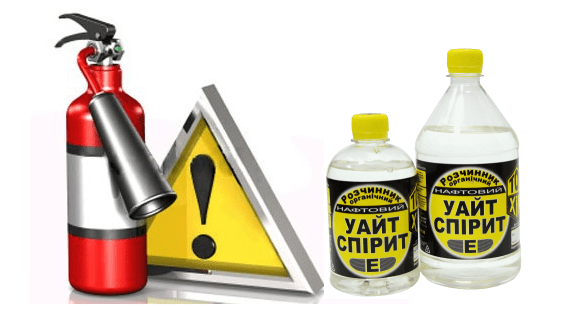
White spirit is used as a solvent in the production of film-forming petroleum substances, for removing fats, lubricants, grinding and polishing pastes, as well as for dissolving and diluting paint and varnish materials. It has a good dissolving capacity, a fairly high boiling point (150-200 ° C), lower toxicity and a lower explosion and fire hazard compared to other petroleum solvents.
According to fire hazard parameters, white spirit belongs to 2 categories of flammable products. It self-ignites already at 270 °C, and has a flash temperature of 33 °C), the explosive limit of white spirit vapors mixed with air is 1.4-6.0%. Therefore, in the room where the solvent is located, it is impossible to light an open fire, and the lighting must be non-explosive. Generally, mechanical ventilation is sufficient to ventilate white spirit vapors.
If it is necessary to open a container with white spirit (GOST 3134-78), then you cannot use tools that can give a spark. Let’s say, during the dissection of an iron barrel, to use an electric saw for metal. White spirit cannot be poured or pumped with compressed air. The spilled solvent is collected in a separate container, and then the spill site must be wiped with a dry cloth. When spilled outdoors, it is covered with sand, which must be collected and disposed of. If the white spirit catches fire, it can be extinguished with any means of extinguishing fire, except water.