
Many areas of modern life are hard to imagine without solvents. They are used in everyday life, industry, paintwork, for cleaning surfaces and tools, etc.
The most popular type of solvent is white spirit. The wide use of this liquid is due to the fact that this solvent is one of the safest and most environmentally friendly options.
What is white spirit?
White spirit (White Spirit) is an organic solvent obtained by direct processing (oil distillation).
The liquid is colorless, transparent and slightly oily (resembles machine oil in consistency) with a low degree of danger (group 4).
Usually, domestic white spirit has a rather sharp smell, but European versions of this solvent are free of this drawback due to the fact that they undergo additional stages of purification. However, not everything is so simple here either: when the degree of purification is higher, it reduces the level of solubility, so it is important to understand that the consumption of European white spirit will be greater.
White spirit is a solvent that does not have a clear formula, because it is made by distillation and the composition depends on the raw material.
The main characteristics of white spirit:
- density: 0.79 g/cm3 (at 20 °C);
- volatility according to xylene: 3-4.5;
- boiling point: 165 °C;
- flash point: not less than 330 °C.
Features of the white spirit solvent:
- rapid evaporation after application;
- possibility to use for internal works;
- effective when diluting paints and varnishes;
- insignificant consumption of material;
- excellent degreasing of many types of surfaces, compared to other solvents;
- resistance to adverse storage conditions, white spirit does not lose its properties for a long time;
- low volatility;
- low toxicity and safe use (due to the reduction of paraffin in the composition of this substance);
- good price.
The history of the creation of white spirit
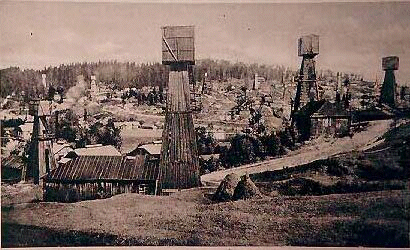
The history of the creation of the first white spirit refers to the beginning of active oil cracking by American industrialists.
In their stills, they initially received only crude hydrocarbon compounds rich in sulfur and impurities. However, at the dawn of the twentieth century, they created distillation columns in which the decomposition of boiling oil took place without access to air. Oil in cracking columns at different heights boiled at different temperatures, resulting in different mixtures of hydrocarbons with different properties.
The main direction of search for oil producers at that time was obtaining lighting kerosene, technical kerosene and various gasolines. Kerosene was needed for lighting the streets and refueling tractor engines, while cars and electric generators began to be filled with gasoline. In the future, industrialists had a need for aviation kerosene, which should be free of impurities and have a high combustion temperature.
It was during the search for such kerosene that a substance was obtained, outwardly similar to it, but with other properties – firstly, it did not want to ignite and burn quickly, secondly, it did not emit the necessary temperature during combustion. This is how white spirit was first formed.
Upset industrialists called it white spirit, that is, white alcohol, as it was similar in chemical properties to methyl alcohol. In those days, it was firmly believed that everything can be produced from oil, including food and drinking alcohol. The version that the name translates as “white spirit” was invented later by non-American people who were romantically inclined to mysticism.
Poisoning with methyl alcohol, and with it white spirit, occurred at the beginning of the twentieth century no less than at the beginning of the twenty-first century. White spirit, when taken internally, produces a strong chemical burn of the stomach walls, and if the stomach is NOT washed immediately with a large amount of water, the consequences for a person will be catastrophic.
“White alcohol” had unique properties to dissolve fatty compounds on any surfaces, which was immediately adopted by industrialists all over the world. White spirit is especially good at cleaning surfaces before priming or painting.
Its main disadvantages include a large number of odorous components that immediately produce an unpleasant smell. This smell persists for a long time, even after the painted surface has dried, so in the future, all over the world, it was decided to add small amounts of fragrant substances to the composition of white spirits.
Fields of application of white spirit
White spirit is mainly used as a solvent for oil fractions, sulfur compounds, nitrogen and oxygen. This solvent is used in many industries and in everyday life.
Use of white spirit in everyday life
White spirit is used in everyday life due to its low volatility and relatively low toxicity. It is indispensable for removing the protective film from metal-plastic windows, and is also widely used for removing silicone sealant after finishing work.
It is often used to remove fuel oil and bitumen stains from clothes and shoes. White spirit is great for cleaning floors (linoleum, parquet and laminate), because it can easily remove stains of fat, blood, ink, paint, etc.
Application of white spirit in various industries
This solvent is widely used in various industries for:
- production of paints and varnishes;
- creation of liquids used to treat a wooden surface to protect against mold and fungus;
- production of primers;
- production of grinding and polishing pastes;
- production of oil, bitumen and their derivatives.
In addition, white spirit has found its application in the wood chemical, paint, rubber and food industries as a solvent.
Use of white spirit as a solvent
In general, the solubility of white spirit is average, but it is widely used for diluting various types of materials in order to achieve the required consistency. At the same time, the solvent is added to the material and moved until the mixture becomes homogeneous.
White spirit with the following materials is used:
- antibacterial liquids for wooden surfaces;
- oils;
- alkyd enamels;
- alkyd varnishes;
- varnish;
- rubber and bituminous mastics.
It is not surprising that such a universal solvent is often used during painting work to dilute the paint before application. In this case, the paint is much easier to apply, dries faster, and the costs of the material itself are reduced.
As a solvent, white spirit is also used for diluting putties, such as:
- oil-styrene;
- alkyd-styrene;
- melamine;
- pentaphthalic;
- urea.
Using white spirit as a cleaner
As mentioned earlier, white spirit perfectly cleans surfaces from grease stains, ink, fuel oil, bitumen, etc. However, the role of white spirit as a cleaner does not end there!
As a cleaner, white spirit is used for:
- removal of remnants of old paint and putty, which helps to prepare the surface for further processing;
- removal of glue residues from scotch tape and rosin stains;
- degreasing of natural skin;
- removal of mold and fungus from wood;
- degreasing of metal, glass, rubber and wooden surfaces;
- cleaning painting tools;
- removal of impurities from various parts;
- washing mechanisms;
- removal of bitumen, oil and wax contamination from various surfaces.
White spirit and its use in the automotive industry
Among drivers, white spirit is popular for removing car mastic. This solvent is an excellent cleaner for all bitumen-based compounds, as well as for shale mastics. It is often used to clean car parts from special lubricants used to protect against corrosion.
It is important to remember that white spirit has a high corrosive activity, so its long stay on the car surface can damage it.
Which is better solvent or white spirit?
In order to understand which solvent is better to choose, you need to understand how they are similar and different.
Solvent and white spirit are both solvents that are made by distilling crude oil, but there is a temperature difference:
- Solvent – at a temperature of 130 to 150°C, evaporation of hydrocarbons occurs.
- White spirit – at a temperature of 155 to 200 °C, hydrocarbon mixtures evaporate.
Aromatic hydrocarbons evaporate from oil at low temperatures and make up to 56% of the total mass in the solvent. The mass of such hydrocarbons for white spirit should not exceed 16%.
In addition to cracking oil, the solvent can also be produced when coke is obtained from hard coal. Such coke gas contains up to 60% light aromatic hydrocarbons. Due to the higher content of aromatic hydrocarbons, the solvent, in comparison with white spirit, has a sharper smell. Prolonged work with the solvent in a non-ventilated room can cause headaches and hallucinations.
Properties that differ among themselves include:
- liquid color: solvent can have a yellowish tint, white spirit is always transparent;
- drying time: solvent dries within 10-20 minutes, white spirit – within 1-2 hours;
- decorative properties: the solvent gives surfaces a glossy appearance, white spirit – a matte surface with an additional film on top;
- application: the solvent is mostly used for cleaning metal surfaces and car parts, white spirit is mostly used by manufacturers of paint and varnish materials and consumers in everyday life.
Such properties include:
- as solvents: solvent and white spirit perfectly dissolve oil paints and fats, the solvent also copes well with nitro paints;
- production: both solvents are used in the production of glyphthalic, pentaphthalic, alkyd and bituminous paints and varnishes, when removing old dried paints and when removing grease stains before painting;
Due to the absence of a sharp smell and not too fast drying time, it is white spirit that is most often used by paint manufacturers.
So, returning to which solvent is better, we can say that the choice of this product depends only on the area where you are going to use it, as well as personal preferences and requests.
Safety rules when working with white spirit
Although white spirit is classified as a substance with a low degree of danger, compliance with safety rules is extremely important:
- Fire-safe storage: Keep the white spirit container away from fire and heat sources. When mixing, do not use devices that can cause sparks. If this solvent catches fire, extinguish the flame with sand or foam.
- Room ventilation: ensure good ventilation if the work will be carried out indoors.
- Protective clothing: White spirit can cause dermatitis and allergic reactions if it gets on the skin, so you should work in protective gloves and clothes to prevent the substance from coming into contact with the skin.
- Respirator: In order to protect the respiratory tract and mucous membranes, a respirator should be worn, especially if white spirit is used in a closed room with poor ventilation.
Frequently asked questions
What is white spirit and what is it used for?
White spirit is an organic solvent that is widely used for the production of paints, as well as for their dilution. It is also used for degreasing surfaces and cleaning tools and mechanisms.
Why is white spirit used instead of water?
White spirit is used in the paint industry due to its excellent solvent properties in relation to a wide range of LFM. It perfectly degreases surfaces and dilutes paints, while it has a low degree of toxicity.
How much does white spirit cost?
The approximate price range for white spirit is UAH 85-150 per liter.