
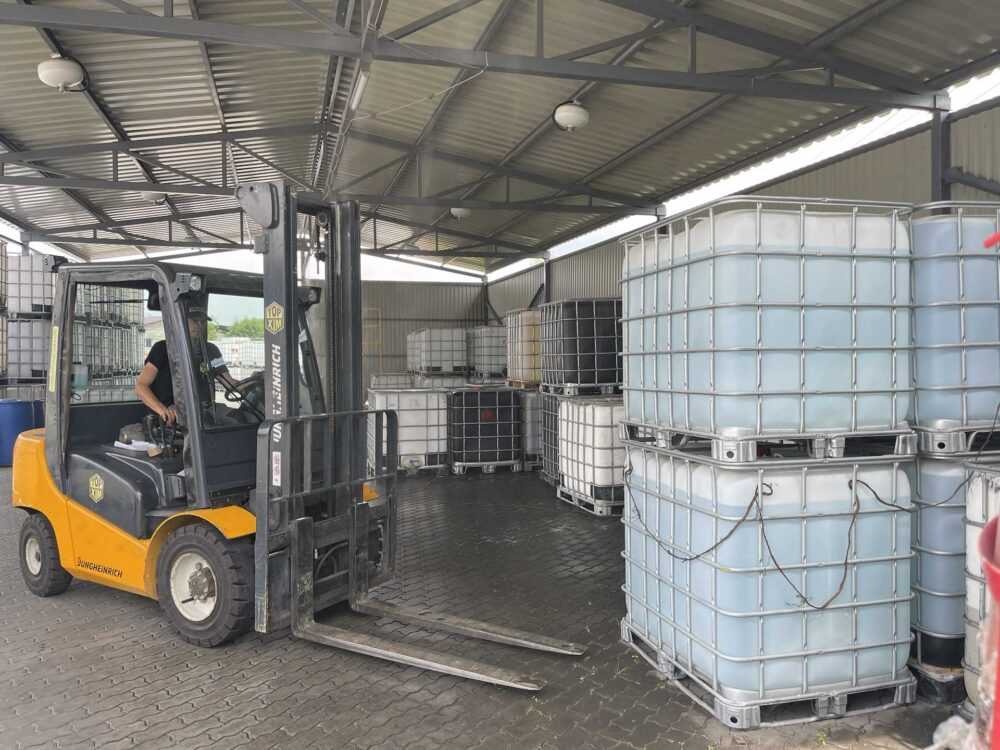
The most popular types of organic solvents used in the chemical industry:
Acetone is a liquid that boils at 56 ° C. The density of acetone is 0.79-0.793 g/cm3. Its flash point is 18 °С. Acetone is mainly used as an additional component in the composition of other solvents. White spirit is used for diluting oil and oil-resin enamels and varnishes. The boiling point is from 165 to 200 °C. The flash point is 33 ° C. The density does not exceed 0.795 g / cm3. The main field of application is the dilution of enamels on an oil and oil-resin basis.
Pure coal and petroleum benzene is a colorless, easily boiling, aromatic liquid. Boiling point 79-80.6 °C, flash point 11 °C. The density of benzene is 0.875-0.880 g/cm3. Due to significant toxicity, it is used to a limited extent in the composition of some solvents.
Butyl acetate has a boiling point of 112-135 ° C. Flash point of 29 ° C. Density 0.87-0.89 g / cm3. It is widely used as a solvent.
Turpentine is a product consisting of a mixture of terpene hydrocarbons. It is obtained from pine, cedar, fir and divided as follows: turpentine – terpene oil, extractive turpentine and some others. The boiling point is 150-170 °C, the flash point of vapors is about 30 °C. The density of turpentine is 0.85-0.87 g/cm3. The main field of application: dilution of glyftal, oil, resin and other LFM.
Toluene petroleum pure, coal pure – these are colorless, evaporate without a residue, flammable liquids. The boiling point is 109-111 ° C, the flash point of vapors is 4 ° C. The density of toluene is 0.860-0.867 g / cm3. It is used as a component in some solvents. Cyclohexanone is a liquid with a boiling point of 150-158 ° C and a flash point of 63 ° C. Density 0.940-0.954 g / cm3. It is used for diluting polyurethane varnishes and enamels.
Ethyl acetate is a very common solvent. Boiling point 70-80 ° C, vapor flash point 2 ° C. Density 0.885-0.905 g / cm3.
Ethyl alcohol is ethanol. Depending on the method of production, rectified alcohol, technical hydrolysis alcohol, and synthetic alcohol are distinguished. Boiling point 78 ° C, vapor flash point 13 ° C. Density 0.79-0.804 g / cm3. It is used as a component in some solvents, as well as for diluting bakelite varnish.
Solvent 645 contains 18% amyl acetate or butyl acetate, 9% ethyl acetate, 3% acetone, 10% butanol, 10% ethanol, and 50% toluene. The volatility of the solvent in ethyl ether is from 10 to 12. It is used for diluting nitrocellulose varnishes, enamels and nitro putties.
Solvent 646: 10% butyl acetate, 8% ethyl cellulose, 7% acetone, 10% butanol, 15% ethanol, and 50% toluene. Volatility is from 8 to 16. Auto-ignition temperature is 403 ° C. The lower permissible explosive limit of vapors of the composition in a mixture with air is 60.2 mg/l. It has a density of 0.83 g/cm3, viscosity according to VZ-4 – 10 s. It is used to dissolve nitrocellulose varnishes, enamels and general-purpose putties.
Solvent 647 is as follows: amyl acetate or butyl acetate 29%, ethyl acetate 21%, butanol 7% toluene 42%. The volatility index for ethyl ether is from 8 to 12. It is used for diluting nitrocellulose varnishes and enamels.
Solvent 648 has the following composition: 50% butyl acetate, 20% toluene, 20% butanol, and 10% ethanol. The volatility index for ethyl ether is from 11 to 18. It is used mainly for diluting nitrocellulose paint and varnish materials, as well as for smoothing scratches and strokes by spraying nitroenamel coatings. Solvent 650 is a mixture of aromatic hydrocarbons, esters and alcohols. It is used mainly for diluting paints, primers, varnishes and enamels (especially for trucks).